Home >> News Events >> Events >> Training >> Northern Cape Project (Phase 2a | Frances Baard, 2022-2023): Training Programme 2022

Northern Cape Project (Phase 2a | Frances Baard, 2022-2023): Training Programme 2022

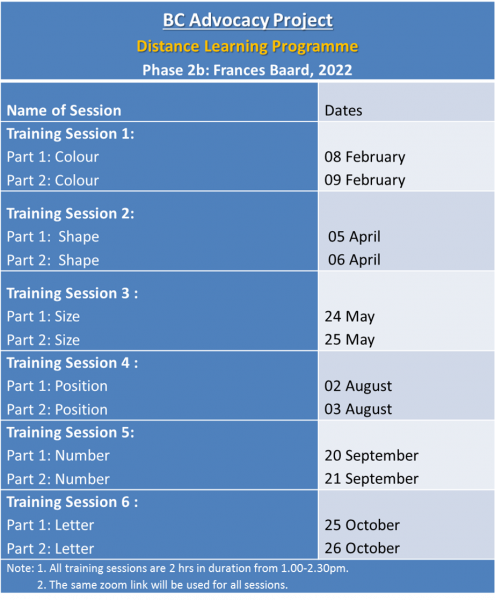
Tuesday, February 8, 2022 - 13:00 to Wednesday, February 9, 2022 - 14:30
Tuesday, April 5, 2022 - 13:00 to Wednesday, April 6, 2022 - 14:30
Tuesday, May 24, 2022 - 13:00 to 14:30
Tuesday, August 2, 2022 - 13:00 to Wednesday, August 3, 2022 - 14:30
Tuesday, September 20, 2022 - 13:00 to Wednesday, September 21, 2022 - 14:30
Tuesday, October 25, 2022 - 13:00 to Wednesday, October 26, 2022 - 14:30
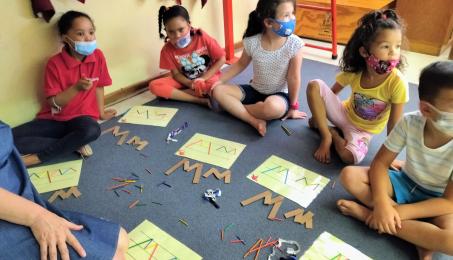
Frances Baard: Training and Mentoring Programme

A group of 30 teachers will be added to the current cohort of 56 teachers in 2022.

Each of the three officials from the district has invited 10 new teachers mostly from their current schools to join the project.

The teachers will attend two training sessions per conceptual domain over the course of the year. See the programme below.

The teachers are required to apply what they have learnt during training inside their classes and share best practices on a dedicated social media site.
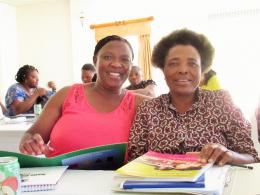
Basic concept is about improving teaching methods, language and the learning processes of our learners.

Pixley Kaseme: Training Sessions 1+2

Goals and objectives were clear, easy to grasp and manageable.  The enthusiasm and energy with which the course was presented made for an enjoyable 3 days!  

Open Public Training, 2015 (Cape Town)

‘All foundation phase educators, esp. Grade R, should attend this workshop. If everyone in the education system uses this BCP model, we should see remarkable improvements in the learners' LIT/NUM over a couple of years.’ (Metro North, 2009)

Teacher Feedback

The Basic Concepts Programme is basically the same as Vygotsky's Zone of Proximal Development. It is a way of teaching… it gives individuals a way to structure their thinking and reasoning. 

Mitchell's Plain Primary School, November 2015

Before the course, I never focused on the main concepts as I never really thought them essential to "real life" as a speech-language pathologist. I now have a very different perspective on why these aspects are important and how they move cognition forward.

ZOOM TRAINING 2 FEEDBACK

Teachers use questions that evoke thinking and inquiry, so that the learners are able to discover and experience for themselves.

Metro South Training, Western Cape Education Department, 2015