Home >> News Events >> Events >> Training >> Namaqua Education District (Phase 2): Training of Northern Cape Department of Education Officials

Namaqua Education District (Phase 2): Training of Northern Cape Department of Education Officials

Tuesday, May 17, 2016 - 09:00 to Wednesday, May 18, 2016 - 16:00
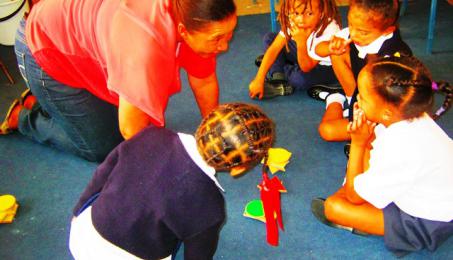
We will be training 14 ECD officilals from the Northern Cape Department of Education (NCDOE) as mediators of the Basic Concepts Programme.

The officials, as part of their training, will shadow the teachers who have recently started Phase 2 of the Namaqua District project.

The officials will continue their training in the Namaqua District.

Our formal partnership with NCDOE aims to start the process of scaling Basic Concepts to all Grade R teachers in the Northern Cape.


Training Details:

Dates: 17 - 18 May 2016

Time: 9am - 4pm

Place: Kimberley, Northern Cape

Venue: Teacher's Centre

For more information contact: Mrs Seapei Lepita (see email address below)

The Basic Concepts Programme is basically the same as Vygotsky's Zone of Proximal Development. It is a way of teaching… it gives individuals a way to structure their thinking and reasoning. 

Mitchell's Plain Primary School, November 2015

I really cannot wait to start- I want all my children to be Grade 1 ready at the end of this year.

Metro South Training, Western Cape Education Department, 2015

The workshop was very educative and an eye-opener. These are things that we usually just take for-granted.

Kwena Basic Education Trust

For me the most effective aspect was the basic teaching model.  When I implemented the model I found that my learners were more focussed when I followed the steps of the model.

Ikwezi: Schools Development Unit, July 2014

This is an excellent programme that can benefit any learner or educator.

Metro Central (2013): Training
Metro Central Education District

‘All foundation phase educators, esp. Grade R, should attend this workshop. If everyone in the education system uses this BCP model, we should see remarkable improvements in the learners' LIT/NUM over a couple of years.’ (Metro North, 2009)

Teacher Feedback